
Monetary policy influences inflation, employment, and economic activity. A stable but dynamic monetary system is vital for supporting economic growth, individual liberty, and a prosperous society. Therefore, we examine the causes and consequences of monetary policy (including inflation), identify ideal and practical steps towards a better monetary policy regime, and look at monetary alternatives and financial regulation.
Articles
No, AI Won’t Make Money Obsolete
Even in a world of radical abundance, scarcity, tradeoffs, and uncertainty persist — and with them, the essential role of prices.

Energy Price Hikes Only Exacerbate Persistent Inflation Problem
Oil price spikes matter, but the evidence points to excess nominal spending as the primary source of sustained inflation.

Powell Exits a Fed Fractured by Inflation Debate
As the Fed prepares for a new chair, the FOMC's disagreement isn’t the timing of rate changes, but fundamentally different views about what causes inflation.
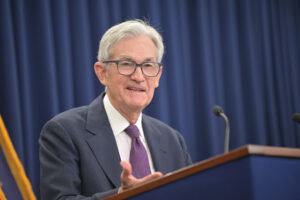
Supply Shocks Plus Inflation Bind the Fed’s Hands
Energy-driven inflation and slowing growth have put the Fed in a difficult position. A look at monetary policy rules shows why holding rates steady may be the most prudent response.

From Shakespeare to Smith: Why Credit Exists in Every Western Society
Credit is not an artificial construct imposed by financiers or states. It arises because modern commercial life cannot function without it.

Business Conditions Monthly February 2026
Forward-looking indicators are weakening, coincident data are softening, and only lagging measures still reflect past strength. February’s BCM suggests the economy is losing momentum.

AI Abundance Won’t End Inflation, Nor Make Money Meaningless
Elon Musk claims AI-driven growth could fund UBI transfers without inflation. But relative prices — not just totals — still drive economic allocation.

Taxing, Borrowing, and Printing: Three Ways America Pays for Government
Tax bills are only the beginning. Borrowing and inflation also finance federal spending — in ways that are easier to ignore but harder to escape.

The Housing Crisis Is a Supply Problem
Rising prices make us look for someone to blame, but the broken market has a simple cause: it's illegal to build enough homes.

Headline Inflation Surged in March, but Core Remained Muted
March’s inflation spike looks alarming, but it's driven entirely by energy shocks. Strip that out and the trend looks largely unchanged.

Research Publications
On the origins of cryptocurrencies
WJ Luther, N Sridhar. A Modern Guide to Austrian Economics, 200-215, 2022
Seigniorage payments and the Federal Reserve’s new operating regime
BP Cutsinger, WJ Luther. Economics Letters 220, 110880, 2022
Central bank independence and the Federal Reserve’s new operating regime
JL Jordan, WJ Luther. The Quarterly Review of Economics and Finance 84, 510-515, 2022
The Value of Bitcoin in the Year 2141 (and beyond!)
JR Hendrickson, WJ Luther. The Economics of Blockchain and Cryptocurrency, 51-68, 2022
Cash, crime, and cryptocurrencies
JR Hendrickson, WJ Luther. The Quarterly Review of Economics and Finance 85, 200-207, 2022
Book Review: Money and the Rule of Law: Generality and Predictability in Monetary Institutions
PC Earle. Quarterly Journal of Austrian Economics 24 (4), 2022
General Institutional Considerations of Blockchain and Emerging Applications
PC Earle, DM Waugh. The Emerald Handbook on Cryptoassets: Investment Opportunities and …, 2023
Cryptocurrencies, Blockchain, and Public Choice
RM Yonk, D Waugh. Cryptocurrency Concepts, Technology, and Applications, 2023
Money, Power, and the People: The American Struggle to Make Banking Democratic by Christopher W. Shaw
RE Wright. Journal of Interdisciplinary History 52 (4), 624-626, 2022
Stephanie Kelton, The Deficit Myth: Modern Monetary Theory and the Birth of the People’s Economy. New York: public affairs, 2020. Xi +325 pages. 30.00 USD …
TL Hogan. The Review of Austrian Economics, 1-4, 2022
War, money & economy: Inflation and production in the Fed and pre-Fed periods
TL Hogan, DJ Smith. The Review of Austrian Economics, 1-23, 2022
Comment on Docket No. OP-1793,’Principles for Climate-Related Financial Risk Management for Large Financial Institutions’
TL Hogan. OP-1793,’Principles for Climate-Related Financial Risk Management for Large …, 2023
Inflation, Tangential Goals, and the Fed’s Dual Mandate
TL Hogan. Cato Institute, 2022
Books


